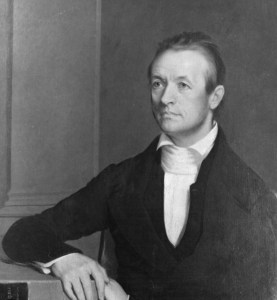
Adoniram Judson and the Glorious Story of the Gospel

In the year 1812, Adoniram Judson left the united States for the nation of Burma, the first American international missionary. Judson worked, sacrificed, suffered, and honored the Lord in that difficult land until his death in 1850, nearly thirty-eight years later. The work in Burma was incredibly difficult, and Judson only baptized his first convert after seven hard years of toil. Judson would suffer sickness and imprisonment and would grieve the deaths of two wives and seven of his thirteen children. Eventually, Judson would successfully translate the Bible into Burmese, develop the first English-Burmese dictionary, see many people come to Christ, and help many missionaries take up the cause.

In 1845, after 33 years overseas, Judson returned to the United States for the first time, grieving the death of his second wife who died on the journey. Arriving in Massachusetts, Adoniram expected that no one would think anything of him or his work. But the missionary was surprised. Among churches in New England, especially Baptist churches, the name of Adoniram Judson had become legendary. And during his time in the states, Judson was overwhelmed with what he believed to be too much attention.

During his visit, Adoniram regularly refused to tell missionary stories that would fascinate people about him or his work, sometimes refusing to speak to groups at all and sometimes speaking only simple, gospel messages. After one such presentation, a lady named Emily, who would soon become Judson’s third wife and join him on the mission field, asked Adoniram about why he did not give the people more of a story. Here is how a biographer of Judson explained the exchange:

As he sat down [Emily recollected]… it was evident, even to the most unobservant eye, that most of the listeners were disappointed. After the exercises were over, several persons inquired of me, frankly, why Dr. Judson had not talked of something else; why he had not told a story … On the way home, I mentioned the subject to him.

“Why, what did they want?” he inquired; “I presented the most interesting subject in the world, to the best of my ability.”

“But they wanted something different—a story.”

“Well, I am sure I gave them a story—the most thrilling one that can be conceived of.”

“But they had heard it before. They wanted something new of a man who had just come from the antipodes.”

“Then I am glad they have it to say, that a man coming from the antipodes had nothing better to tell than the wondrous story of Jesus’ dying love.”1

There is something beautiful in Judson’s response to Emily. People admired the legendary missionary. But for his part, Judson wanted people to glory in Jesus.

1 Courtney Anderson, To the Golden Shore: The Life of Adoniram Judson (Valley Forge, PA: Judson Press, 1987), Kindle Edition, 431.

Trusting in Your Own Reason or in the Word of God

In 1819, Adoniram Judson was taking the gospel to Birma. In a conversation with a local, Judson saw that a man almost believed but struggled with accepting the truth of Scripture over his own reason. The following exchange is both an encouraging story and a reminder that we who share the gospel must not compromise the message for the sake of a quick profession of faith:

They were well into their preparations when old Maung Shway- gnong paid the mission another visit. He no longer would go near the zayat, but he did not seem to be able to stay away from Adoniram. This time he spent hours raising hair-splitting objections, all of which Adoniram answered fully. Suddenly Maung Shway-gnong admitted that he did not believe a word of what he had been saying. He had merely been trying to test Adoniram and his religion.

"Do you think I would pay you the least attention if I found you could not answer all my questions and solve all my difficulties?" he said. He really did believe in God, in His son Jesus, and in the atonement. In short, he was a Christian at heart.

Adoniram was skeptical. "Do you believe all that is contained in the book of St. Matthew that I have given you? In particular, do you believe that the Son of God died on a cross?"

"Ah, you have caught me now," the old teacher admitted with some chagrin. "I believe that He suffered death. But I cannot admit He suffered the shameful death of the cross."

Adoniram, knowing Maung Shway-gnong, had expected the answer. It was difficult for a Burman, particularly a high-born scholar, to imagine a God who would permit His Son to undergo any kind of indignity. The whole idea was abhorrent. Adoniram pressed home its meaning: "Therefore you are not a disciple of Christ. A true disciple inquires not whether a fact is agreeable to his own reason, but whether it is in the book. His pride has yielded to the Divine testimony. Teacher, your pride is still unbroken. Break down your pride, and yield to the word of God."

Maung Shway-gnong stopped to think. Then he said: "As you utter those words I see my error. I have been trusting in my own reason, not in the word of God." Someone entered and he fell silent. When the intruder left after a little while, he said thoughtfully, "This day is different from all the days on which I have visited you. I see my error in trusting in my own reason; and I now believe the crucifixion of Christ, because it is contained in the Scripture." They talked for a while at random and the conversation led to the uncertainty of life. Maung Shway-gnong had a new thought. "I think I shall not be lost even though I should die suddenly."

"Why?"

"Because I love Jesus Christ."

"Do you really love Him?"

"No one that really knows Him can help loving Him," said the old man with feeling; and so departed.

Anderson, Courtney. To the Golden Shore: The Life of Adoniram Judson (pp. 223-224). Judson Pr. Kindle Edition.

The Regulative Principle Frees us from Bondage and Legalism

Doing a little study on the Regulative Principle of worship for an upcoming class, I came across this quite helpful application in an article by Derek Thomas:

What is sometimes forgotten in these discussions is the important role of conscience. Without the regulative principle, we are at the mercy of “worship leaders” and bullying pastors who charge noncompliant worshipers with displeasing God unless they participate according to a certain pattern and manner. To the victims of such bullies, the sweetest sentences ever penned by men are:

God alone is Lord of the conscience, and hath left it free from the doctrines and commandments of men, which are, in anything, contrary to His Word, or beside it, in matters of faith or worship. So that to believe such doctrines, or to obey such commands out of conscience, is to betray true liberty of conscience: and the requiring of an implicit faith, and an absolute and blind obedience, is to destroy liberty of conscience, and reason also. (WCF 20:2)

To obey when it is a matter of God’s express prescription is true liberty; anything else is bondage and legalism.

Thomas, Derek. “The Regulative Principle of Worship.” Ligonier, November 12, 2021. Accessed 22 Jul 2024, https://www.ligonier.org/learn/articles/regulative-principle-worship.

Neil Shenvi’s Why Believe — A Review

Neil Shenvi. Why Believe?: A Reasoned Approach to Christianity. Wheaton: Crossway, 2022. 272 pp.

Over the past few years, the name Neil Shenvi has become known among certain Christian circles. Shenvi, a PhD research scientist and homeschooling dad of four, has offered a great deal of helpful and gracious material regarding the issue of critical theory in a variety of arenas. So, when I saw that he was releasing an upcoming book offering a reasoned approach to the believability of Christianity, I immediately reached out to the publisher for my review copy. I was not disappointed!

In Why Believe, Shenvi takes his readers through a variety of thoughtful arguments that point to the reasonability and believability of the faith. Borrowing from thinkers such as C. S. Lewis, Shenvi challenges readers to seriously consider the claims of and about Jesus. Looking at science, Shenvi points to evidence for God in nature, even in astronomy. And, telling his own story, the author helps his readers to see how a reasonable, thoughtful, scientifically minded man moved from skepticism to belief.

As I read through this work, I found myself particularly enjoying the logical construction of Shenvi’s arguments. Perhaps this is because of his scientific background. Whatever the reason, I find that Shenvi’s writing is something I would not hesitate to recommend to a thoughtful person who is not sure about the veracity of the Christian claim. And, honestly, this is not something I would say about every apologetic text out there.

Understand what you are getting in picking up this book. Shenvi is not writing to solve every theoretical problem with the faith or to settle every objection potentially posed. This book is evidential apologetics and not presuppositional in nature—though Shenvi never attempts to find that elusive and nonexistent neutral starting point. He will not settle for you arguments about the age of the earth or the problem of evil. Instead, in many ways, Shenvi simply takes the objections to the faith that we often encounter and presents very reasonable responses to show that the faith is at least as credible as any alternative theory. For example, in response to naturalistic attempts to explain away the accounts of Jesus’ resurrection, Shenvi points out that, when all evidence is weighed, the possibility of resurrection is only less likely if one assumes the impossibility of anything supernatural.

I happily recommend that believers interested in a new, clear, helpful evidential apologetics book pick up Shenvi’s work. Perhaps his words can open doors for skeptics to give consideration to the faith they assume to be illogical on its surface. Only the work of Almighty God can convert a soul, and I would certainly never suggest otherwise. But, perhaps the Lord will use these encouraging and well-reasoned arguments to at least make someone sit down and talk.

I received a free copy of this book from the publisher in exchange for an honest review.